If you’ve ever walked through a bustling distribution center at 2 a.m., when the only sounds are the whir of conveyor belts and the sharp, consistent clank of heavy boxes stacking onto a pallet, you’ve probably seen a palletizing robot at work. For too long, industries relied on manual labor to move and stack products weighing 50, 100, even 200 pounds—work that not only exhausted workers but also carried serious risk of injury, slowed output, and limited consistency. As a palletizing robot supplier, I get asked the same question almost every day: How do these machines handle such heavy loads without breaking, malfunctioning, or sacrificing precision? It’s not just about strength; it’s about a combination of engineering, smart programming, and built-in safety that turns what once was high-stakes manual work into a reliable, seamless process. Let’s break down exactly how it works. Palletizing Robot
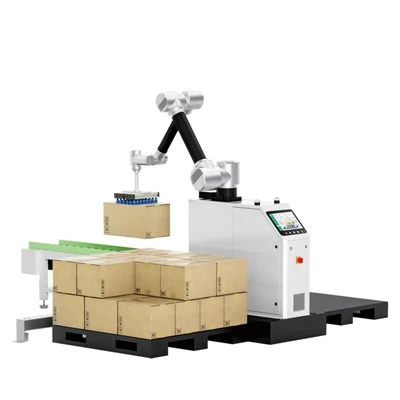
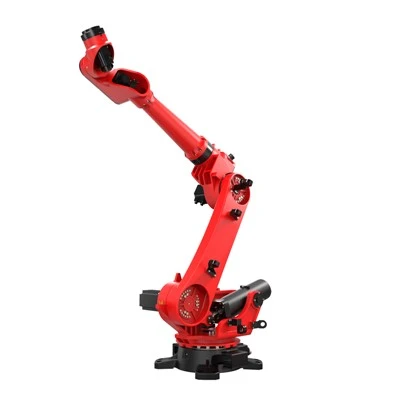
First, the foundation of any heavy-duty palletizing robot starts with its structural design. Not every robot is built the same—you don’t use a 50-pound robot arm to stack 200-pound automotive parts, just like you wouldn’t use a heavy-duty forklift to move a single laptop. The robots we supply, for example, are engineered with high-tensile steel frames and reinforced joints, not the lightweight aluminum used for smaller, light-payload robots. These robots use rigid rotary joints and heavy-duty gearboxes, often harmonic drives or planetary gear systems, that are designed to transfer massive amounts of torque without flexing. Flex is the enemy here—if the arm bends even a fraction of an inch when lifting a 150-pound bag of concrete, the entire stack will be off-kilter, leading to collapsed pallets or damaged products. That’s why we test every single robot for structural integrity before it leaves our facility: we simulate 10,000 cycles of lifting maximum payloads, and check for any residual flex or wear that could cause issues down the line. It’s a step most suppliers skip, but for us, it’s non-negotiable when it comes to handling heavy products.
Next, the end-of-arm tooling (EOAT) is where the robot meets the product, and this is make-or-break for heavy loads. A robot’s arm can be strong, but if the tool it uses to grip the product isn’t designed for the item’s shape, weight, and material, it will drop it. We customize EOAT for every application, because a 100-pound steel coil needs a completely different tool than a stack of 50-pound lumber sheets, or a bag of dog food. For loose, bagged products, we often use vacuum grippers with reinforced, industrial-grade rubber pads that create a tight seal across the entire top of the bag—no uneven pressure that could tear the bag or cause a gap in the grip. For rigid, heavy items like boxes of canned goods or metal parts, we use mechanical grippers with serrated jaws that lock onto the edges of the product, distributing weight evenly across the entire surface. We also include quick-change tooling systems for facilities that handle multiple product types in one shift—instead of stopping operations for an hour to manually swap tools, the robot can switch grippers in under two minutes, keeping throughput high even when working with different heavy products.
Once the physical components are in place, the robot relies on sophisticated programming to handle heavy loads safely and accurately. This isn’t just basic “pick up and place” code; it’s dynamic software that calculates weight in real time, adjusts movement speeds based on load, and maintains consistent stacking patterns to prevent pallet collapse. For example, if a robot is lifting a 180-pound engine block, its controller will instantly recognize the load weight and slow its acceleration during the lift and move phases. Accelerating too quickly with a heavy load would not only put unnecessary strain on the robot’s joints, leading to premature wear, but could also cause the product to shift or fall mid-move. The programming also includes gravity compensation: the robot’s controller constantly adjusts the torque of its motors to counteract the downward pull of gravity on the arm and load, keeping movement smooth even when lifting the heaviest products. That’s a feature we’ve invested hundreds of hours into refining, because it’s the difference between a robot that works reliably for 10 years and one that needs costly repairs every few months.
Another key part of handling heavy products is the integration of safety and precision sensors. These robots don’t operate in a vacuum—they work alongside workers, conveyor belts, and other equipment in a busy facility, so they need to be able to adapt and avoid mistakes. We equip our palletizing robots with high-resolution vision systems and load sensors that work together to catch errors before they cause damage. The vision system scans every product as it comes down the conveyor, checking for damaged edges, mislabeled sides, or incorrect alignment that would make it unsafe to stack. If a robot picks up a product that’s out of alignment, the software will adjust the gripper’s grip to fix it, or send the product to a rejection bin instead of stacking it. The load sensors, mounted in the EOAT and the robot’s base, measure the exact weight of every load being lifted. If the sensor detects a load that’s 10% heavier than expected—say, a bag of fertilizer that’s underfilled in weight but looks full—the robot will trigger an alarm and pause operations, preventing it from attempting to handle a load it wasn’t designed for. These sensors also track wear and tear on the robot’s components, alerting maintenance teams to a worn gear or loose bolt before it becomes a breakdown.
We also can’t talk about handling heavy products without addressing one of the biggest challenges: pallet stability. Even if each individual product is stacked perfectly, a wobbly pallet will collapse, causing delays, product damage, and safety hazards. The robot’s programming takes into account the weight distribution of each product and the pallet’s maximum load capacity. For example, when stacking heavy steel beams, the robot will place the heaviest beams on the bottom of the pallet, spreading the weight across the entire pallet surface instead of concentrating it in the center. For boxed products, it uses a pattern called a “brick pattern” or “column pattern” that interlocks each layer, so the weight of the upper layers is supported by the layers below. We even offer pallet condition checks: before stacking begins, the robot’s vision system scans the pallet to make sure it’s not warped, cracked, or missing boards. If the pallet is damaged, it will send a signal to the conveyor to reject it, saving facilities the headache of a collapsed pallet mid-operation.
Of course, no machine is perfect, which is why the support that comes with a palletizing robot is just as important as the robot itself. As a supplier, we don’t just sell equipment—we work with facilities to test their specific heavy products, adjust the robot’s settings, and train teams to operate and maintain it. We’ve worked with automotive parts warehouses that needed to stack 200-pound engine components, construction supply companies moving 150-pound bags of mortar, and food distribution centers handling 100-pound cases of canned vegetables. For each, we run a trial run at our facility first, testing how the robot handles their exact product, adjusting the gripper, programming, and sensor settings to make sure it works flawlessly. That’s a step many suppliers skip, but it’s critical for heavy products—what works for one type of 100-pound product might not work for another.
I’ve seen first-hand how these robots transform operations. A construction supply company I partnered with a couple years ago was relying on 12 manual workers to stack 80-pound bags of cement, and they were dealing with an average of two work-related injuries a month, plus output that was consistently 20% below their target. After installing our heavy-duty palletizing robot, they cut their injury rate to zero, increased output by 35%, and even reallocated their workers to higher-skill tasks that didn’t involve heavy lifting. The robot has been running three shifts a day, five days a week, for four years with only routine maintenance—no major breakdowns, no dropped products, no collapsed pallets. That’s the power of engineering done right.
If you’re a facility struggling with heavy product handling: facing high labor costs, frequent injuries, inconsistent output, or damaged products from manual stacking, a palletizing robot might be the solution you’re looking for. We specialize in custom solutions for heavy products, and we’d be happy to walk you through how our robots can be tailored to your specific operations, test your products on our equipment, and answer any questions you have about installation, programming, or long-term maintenance. Reach out to our team to schedule a consultation and learn more about how we can help your facility run safer, faster, and more efficiently.
Industrial Robot References
- Robotics Industries Association. (2022). Industrial Robot Safety Standards for Payload Handling.
- International Society of Automation. (2021). End-of-Arm Tooling Design for Heavy Industrial Applications.
- Journal of Manufacturing Engineering. (2020). Dynamic Load Compensation in Heavy-Duty Robotic Manipulators.
- Occupational Safety and Health Administration. (2023). Ergonomic Guidelines for Manual Material Handling.
Robotic Technology (GD) Co., Ltd.
Robotic Technology (GD) Co., Ltd. is one of the most experienced palletizing robot manufacturers and suppliers in China, also supports custom service and one year warranty. Please feel free to wholesale CE approved palletizing robot for sale here from our factory. Contact us for quotation.
Address: Room 102, No. 30,Hengfeng 2nd Road,Daguo, Changping Town, Dongguan City,Guangdong,China
E-mail: admin@iroboticplus.com
WebSite: https://www.rb-tic.com/
