Hey everyone, I’m Jake from a blow molding mold supply company—been in this game for 12 years, helping brands big and small get the right molds to make perfect plastic parts. These days, I get so many confused questions about the two most common blow molding processes: injection stretch blow molding (ISBM) and extrusion blow molding (EBM). A lot of folks mix up their molds, and that leads to so much frustration—wrong part specs, wasted material, even delayed production. Today I’m breaking this down like I would for a client on the phone, no fancy jargon, just real talk about what makes their molds totally different. Blow Molding Mold

First off, let’s do a quick 101 refresh so we’re on the same page. EBM is the old workhorse—you extrude a hollow plastic tube (that’s called a parison) straight from a machine, then pinch it between two halves of a mold and blow air to shape it. Think of big water jugs, detergent bottles, those giant plastic storage tanks—9 times out of 10, those are EBM parts. ISBM is the newer, more precise one, mostly used for small, rigid parts: single-use water bottles, pill bottles, cosmetic jars, even some food containers like yogurt cups. It injects a small, solid plastic “preform” (like a test tube with a threaded neck) first, then stretches it inside the mold before blowing. But the real difference isn’t just the process—it’s the molds, and that’s where I see most guys mess up.
Let’s start with EBM molds because they’re the ones I’ve been building since I got into this. EBM molds are basically two big, heavy steel blocks that split right down the middle. Why so heavy? Because EBM parts don’t have that preform’s neck thread to hold pressure—wait, no, actually let’s rephrase that to make it clear. EBM uses a hanging parison, right? That long, soft plastic tube. When you blow air into it, the whole mold has to clamp down super tight—like 200 to 300 tons of clamp force, sometimes more for big parts. If the mold isn’t heavy and rigid, it’ll flex, and you get uneven wall thickness on the parison when you blow it. The mold’s cavity is shaped exactly like the outside of your part, but the only other features are things like a pinch-off area at the bottom (where you cut off the excess plastic parison) and vent slots to let air escape so there are no bubble splotches. No threads to speak of here—wait, some EBM bottles have a threaded neck, but that’s usually a separate part or a machined indent, not integrated into the mold like ISBM. Also, EBM molds are often made of tool steel or even aluminum for simpler jobs, because you don’t need the ultra-precise surface finish that ISBM requires. Wait, but for high-volume EBM parts, we use P20 tool steel to make them last, right? I’ve had a client running 10 million milk jugs a year, their EBM molds from us are still going strong after 5 years. The big downside of EBM molds: you can’t reuse them for small, precise parts—they’re built for big, bulky stuff where surface finish isn’t top priority.
Now ISBM molds, and this is where people really get tripped up. ISBM isn’t just one process—it’s two-step (most common for large runs) and one-step, but the mold design is almost identical across both. First, you have a preform mold that injects that little threaded test tube, but wait no—the final blow mold for ISBM is totally different from EBM. Let’s get that straight: ISBM’s final mold has three parts, not two. You have the two main cavity halves, but you also have a core rod that stretches the preform vertically during the process. That core rod isn’t just a random stick—it’s precision-machined to the exact dimensions of the part’s internal shape, right? Because when you inject the preform, it’s only about 20% of the part’s final size, and you stretch it with that core rod to get uniform wall thickness. That’s why ISBM bottles are so light—you don’t waste plastic on thick walls, which is huge for cost and sustainability. The mold surfaces for ISBM have to be way smoother than EBM too—think mirror finish for food-grade water bottles, because no one wants a bumpy bottle that’s hard to label. And let’s talk about threads: ISBM molds have integrated threaded inserts for the bottle neck. Those inserts are super precise—if the thread is 0.001 of an inch off, the cap won’t screw on right, and you’ll get leaks. I once had a startup come to me with bad ISBM molds from another supplier—their threads were misaligned, so their whole cap line was down 30% until we remade the inserts. That’s the difference: EBM molds never have integrated threaded neck inserts, because the parison is loose and doesn’t hold the thread shape easily.
Another big difference is how we design the venting in each mold. Venting is where we put tiny little slots (usually 0.001 to 0.003 inches thick) in the mold to let trapped air escape when the plastic is blowing into the cavity. For EBM molds, the air trapped is mostly from the hanging parison sagging—so we put vents along the pinch-off edges and the big flat sides of the mold. Since EBM parts are usually larger and have more surface area, we don’t need ultra-precise venting, just enough to keep from getting those air bubbles. But ISBM molds? The preform is stretched so fast (like, milliseconds) that if air gets trapped anywhere, you get a thin spot right where you don’t want it. So we put vents all around the entire cavity, along the core rod, even near the neck thread inserts. I had a client making 500ml soda bottles—their old ISBM molds had vents only on the sides, so the neck of the bottle was always thin and would crack when filled with carbonated water. We added 6 extra vents around the neck area, and that problem was gone overnight. That’s a small design detail that makes a huge difference.
Material choice for the molds is another thing I get asked about. EBM molds: like I said earlier, for low-volume small parts, we can use aluminum because it’s cheap and easy to machine, but for high-volume big parts (like 5-gallon water jugs), we use P20 tool steel that’s hardened to 30 HRC. That’s because the clamp force on EBM is so high—aluminum would deform after a few thousand cycles. ISBM molds? We almost always use S7 tool steel or even stainless steel for the cavity halves, because they need to hold super tight tolerances for millions of cycles. The threaded inserts in ISBM molds are usually made of hardened tool steel with a coating (like TiN) to reduce wear, since the caps screw on and off thousands of times. EBM parts have threads too, but they’re usually molded as a slightly rounded shape that doesn’t need to be precise enough for repeated screwing, so their inserts (if they even have them) are simpler.
Wait, let’s talk about part compatibility to make this real. If you need a 1-gallon plastic milk jug for a grocery store, EBM is your only option—an ISBM mold can’t make that big, bulky part with thick walls that hold up to stacking. If you need a 500ml plastic water bottle for a convenience store, ISBM is the way to go—you can’t make that with an EBM mold because EBM’s wall thickness is uneven, so you’d have to use way more plastic, making it heavy and expensive. I see people try to force it all the time, and it never works. Last year a food company tried to use EBM molds for their new 250ml sauce bottles, and they ended up with 20% of parts leaking because the neck was too thin from uneven blowing. They came to us, we made custom ISBM molds, and their leak rate dropped to 0.2%—saved them thousands in wasted product.
Also, cycle time is a big factor that ties back to the molds. EBM cycle times are usually 10 to 30 seconds per part, because you’re dealing with a big parison that takes longer to cool. ISBM cycle times are 2 to 5 seconds, way faster, because the preform is small and the stretched plastic cools evenly. Why does that matter for the mold? ISBM molds have cooling channels drilled right into the cavity and core rod, way closer together than EBM molds. EBM molds have cooling channels too, but they’re wider and spaced further apart because the larger part needs slower, more even cooling. If you take an EBM mold’s cooling design and put it in an ISBM mold, the bottle would be too hot to handle, and you’d get warped parts. I learned that the hard way early on—made a test mold for a client mixing EBM cooling, and the first 10,000 bottles were all warped. Had to scrap the mold and start over, cost me a week of work. That’s why I always tell new clients: don’t mix and match mold designs based on what you used before—each process needs its own mold.
Let’s wrap this up with the key points so you don’t have to scribble notes. EBM molds: two heavy, rigid steel/aluminum blocks, no integrated threaded inserts, vents only on high-surface areas, designed for big, thick-walled parts with moderate precision, clamp force 200+ tons, cycle times 10+ seconds. ISBM molds: three precision-machined components (two cavity halves, one core rod), integrated threaded neck inserts, vents across the entire cavity, designed for small, thin-walled parts with tight tolerances, clamp force lower (100 tons max usually), cycle times under 5 seconds. The biggest mistake I see is people thinking they can use the same mold for both, and it never works—each is built for exactly one process, so getting the right mold is make-or-break for your production.
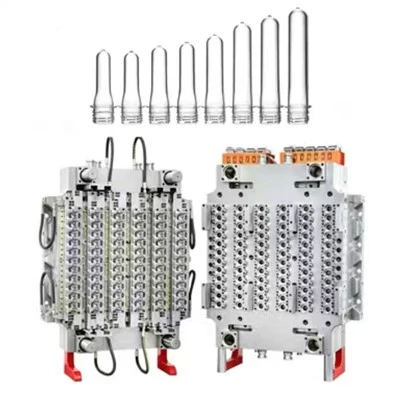
Now, if you’re thinking about launching a new blow molding part, or your current molds are giving you headaches (too much waste, wrong part specs, high cycle times), I’m here to help. I’ve worked with startups and Fortune 500 companies, I don’t do one-size-fits-all molds—we design every mold to your exact part needs, whether it’s EBM for a giant storage tank or ISBM for a luxury cosmetic jar. Hit me up, we can chat through your project, no sales pitch, just real advice to make sure you get the right mold for the job.
Mold Accessories References:
- Rosato, D. V., & Rosato, M. G. (2000). Blow Molding Handbook (3rd ed.). Hanser Gardner Publications.
- Strong, A. B. (2005). Plastics: Materials and Processing (2nd ed.). Prentice Hall.
- Incropera, F. P., & DeWitt, D. P. (2002). Fundamentals of Heat and Mass Transfer (5th ed.). John Wiley & Sons.
Taizhou Leizhen Mold Co., Ltd.
Taizhou Leizhen Mold Co., Ltd. is one of the most professional blow molding mold manufacturers and suppliers in China, also supports customized service with low price. Please feel free to buy CE approved blow molding mold made in China here from our factory. Contact us for pricelist.
Address: No.8828, Changtang Industrial Zone, Beicheng Street, Huangyan District, Taizhou City, Zhejiang Province
E-mail: ningleizhen@gmail.com
WebSite: https://www.leizhenmold.com/
