If you’re deep in the world of sheet metal stamping—whether you’re a job shop owner, a toolmaker, or an engineer just trying to troubleshoot a wonky part—you’ve probably heard terms thrown around like “progressive die” and “die shoe.” But if you’re new to the game, or even if you’ve been around a minute, you might be asking: What the hell is a progressive die die shoe, and why does it matter? As a supplier that’s been building progressive dies for over a decade, I get it—you don’t care about jargon for jargon’s sake. You care about how this part keeps your line running, cuts down on downtime, and doesn’t cost you a fortune in rushed repairs. Let’s break it down straight, no fancy textbook fluff. Progressive Dies
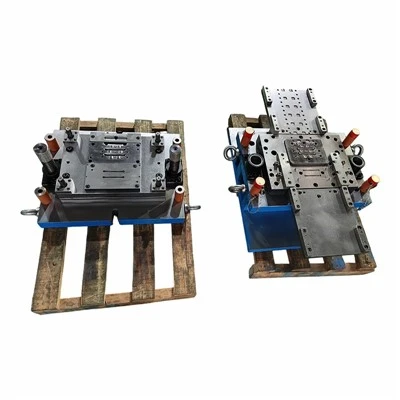
First, let’s back up just a sec. A progressive die is that tool that punches, cuts, forms, and shapes a flat sheet of metal into a finished part—all in one continuous run, right? The strip feeds through station after station inside the die, and each one does a tiny bit of work until the part pops out the end. Now, all those stations, all those punches, dies, and lifters? They’re not just floating around inside the die. They need a solid, rigid base to mount to, something that doesn’t shift when a 200-ton press slams down 20 times a minute. That’s the die shoe. For progressive dies specifically, it’s the backbone of the whole tool.
Let’s get specific about progressive die die shoes, because they’re a little different from the die shoes you’d use for a single-operation blanking die. Single-operation dies might use a simple, thick steel plate as a base, but progressive dies have a ton going on. They need to hold all the tooling aligned perfectly across, say, 8 to 12 stations—if even one punch is off by a hair, you get a misaligned part, scrap, and a dead press. That’s why progressive die die shoes are precision-machined, from solid plates or fabricated steel, with tight tolerances you can’t just eyeball. We’re talking thousandths of an inch here.
Wait, what’s a tolerance, in plain terms? Let’s say you want a hole 0.5 inches wide. A tolerance of +/- 0.001 inches means your hole has to be between 0.499 and 0.501 inches. For a progressive die die shoe, the tolerance for mounting holes or guide posts? Often way tighter—like +/- 0.0005 inches. Why? Because guide posts keep the top half of the die (the punch holder, which mounts to the press ram) and the bottom half (the die shoe) perfectly aligned. If the die shoe’s guide post holes are even a little off, the punch won’t line up with the die cavity, and you’ll get burrs that are way too big, or parts that won’t fit together later.
Now, let’s talk about construction. Most die shoes for progressive dies are made from A36 steel or tool steel, depending on the application. A36 is cheaper, good for lower-volume runs where wear isn’t a huge deal. But if you’re stamping high-volume parts—like 100,000+ a month, say, automotive brackets or electrical contacts—you want a heat-treated tool steel die shoe. It’s harder, more resistant to wear from repeated impacts, so it doesn’t warp or get dented after a few million cycles. I see too many guys cheap out here: they grab a regular steel plate from the local metal supply, machine a few holes, and wonder why their die fails after 50,000 parts. Don’t do that. The die shoe isn’t an afterthought—it’s what all your expensive tooling (the punches, the form tools) is bolted to. If the shoe goes, the whole die goes.
Another thing: progressive die die shoes have extra features you don’t see on single-operation dies. For one, they have strip guide rails machined right into the top surface (the part that feeds the metal strip through the die). Those rails hold the strip straight as it moves from station to station—no wandering, no jamming. If the strip wanders, you get parts that are offset, or even broken tooling. We machine those rails to match the width of your specific metal strip, down to the thousandth of an inch, so there’s just enough clearance for the strip to move without sloshing around.
Then there are the lifter and cam slots. Progressive dies often use lifters to push the part down from the die cavity after a station, or cams to form angles in the metal that you can’t do with a simple punch. Those slots have to be milled into the die shoe with perfect alignment too. If a cam slot is off, the cam won’t slide right, and your form will be wrong. We spend hours verifying those slots with CMM (coordinate measuring machine) checks before we even send a die out the door. That’s not overkill—that’s how we keep downtime low for our customers.
Wait, let’s address a common myth: some people think the die shoe and the punch holder (the top half of the die that mounts to the press) are the same thing. Nope. The die shoe is almost always the bottom half, the one that sits on the press bolster (the flat plate on the press bed). The punch holder is the top half, connected to the press ram. Both need to be rigid, but the die shoe takes a lot of the abuse from the strip feeding through and the die impacts. It’s also where you mount the pick-up legs or die stops—things that keep the die from sliding around on the press bed during setup. That’s critical for repeat runs: if the die moves even a little between jobs, you’re redoing all your setup, wasting time and material.
Why does this matter for you, as someone sourcing or using progressive dies? Let’s talk about real-world examples. A customer of ours last year bought a cheap imported progressive die that came with a thin, poorly machined die shoe. After 20,000 parts, the guide posts had worn a groove into the die shoe’s guide holes, so alignment was off. His line was down for three days while he waited for a new die shoe, costing him over $15,000 in lost production. A good die shoe—machined from proper material, with tight tolerances—lasts millions of cycles. We’ve got dies from 15 years ago running 24/7 that still have original die shoes. That’s the value.
Now, when you’re shopping for a progressive die or a replacement die shoe, what should you look for? First, ask about the material. If they offer only A36 for high-volume runs, that’s a red flag. Second, ask about tolerance. Make sure the guide post holes, strip guides, and any slots are within +/- 0.0005 inches minimum. Third, check if they offer pre-machined mounting holes for your specific press. A lot of guys forget that: the die shoe has to bolt to your press’s bolster, so if the hole pattern doesn’t match, you’re drilling new holes on the press, which is a pain and can weaken the shoe. Fourth, ask about surface finish. The top of the die shoe (where the strip feeds) should be smooth, so the metal doesn’t catch on rough edges. We mill ours to a 125 Ra finish, which is perfect for most strip materials—aluminum, steel, stainless, even copper.
Let’s also cover a quick note on custom vs. off-the-shelf. Wait, are die shoes off-the-shelf? Sort of, but most progressive die applications need custom die shoes. Off-the-shelf plates are good for small, simple dies, but if you’ve got a die with 10 stations, unique strip sizes, or specialized cam/lifter slots, you need a custom-machined die shoe. That’s where a good progressive die supplier comes in—we work with you to design the die shoe to fit your exact tooling, press, and production needs, not just a one-size-fits-all plate.
Another thing people overlook: die shoes for progressive dies need to handle thermal expansion. When a press is running all day, the die gets hot from friction between the metal strip and the tooling. The die shoe has to expand at the same rate as the punch holder, right? If one expands more than the other, alignment shifts. That’s why we use matched steel grades for the die shoe and punch holder when we build a die—same coefficient of thermal expansion, so they move together. No more misaligned parts after an hour of production.
Now, let’s be honest: we’re a progressive die supplier, so obviously we think the die shoe is a big deal. But we don’t just say that because we sell ’em. We’ve fixed more dies where the root cause was a bad die shoe than we can count. Last month, a shop called us because their new progressive die was producing 12% scrap parts. We came in, checked the die shoe, and found that the strip guide rails were milled uneven—one was 0.002 inches lower than the other. That made the strip tilt as it fed, so each station was punching off-center. We milled the die shoe to fix the rails, scrap dropped to less than 1% within an hour. That’s how much a die shoe affects your bottom line.
Wait, let’s wrap this up without making it sound like a sales pitch that’s too pushy. You don’t need to be a tooling expert to know that the die shoe is the unsung hero of your progressive die. It’s not the flashy punch that makes the hole in your bracket, or the form tool that bends your clip, but if it’s not built right, none of that other tooling matters. It’s the base that keeps everything aligned, rigid, and working as it should, shift after shift, run after run.
If you’re working on a new project, troubleshooting a die that’s been giving you grief, or need a replacement die shoe that’s built to last, we’re here to help. We don’t just sell parts—we help you figure out what you actually need, no fluff, no upsell on stuff you don’t want. Whether you’re running 1,000 parts a year or 10 million, we can design and machine a die shoe that fits your press, your tooling, and your production goals. Reach out to talk through your needs—we’d be stoked to help you get your line running smoother.
Progressive Dies References:
- Tool and Manufacturing Engineers Handbook, Volume 2: Forming, Society of Manufacturing Engineers.
- “Progressive Die Design and Tooling,” Stan Johnson, Stamping Industry Association, 2019.
- Precision Sheet Metal Stamping Tooling Standards, International Journal of Manufacturing Technology, 2021.
Dongguan Changdong Tool & Die Co., Ltd.
With abundant experience, we are one of the most reliable progressive dies manufacturers and suppliers in China. Please feel free to buy advanced progressive dies made in China here from our factory. Good service and quality products are available.
Address: No.56-B, Fumin South Road, Dalang Town, Dongguan City, Guangdong Province, China
E-mail: sales@cdstamping.com
WebSite: https://www.metalstampingdie.com/
